
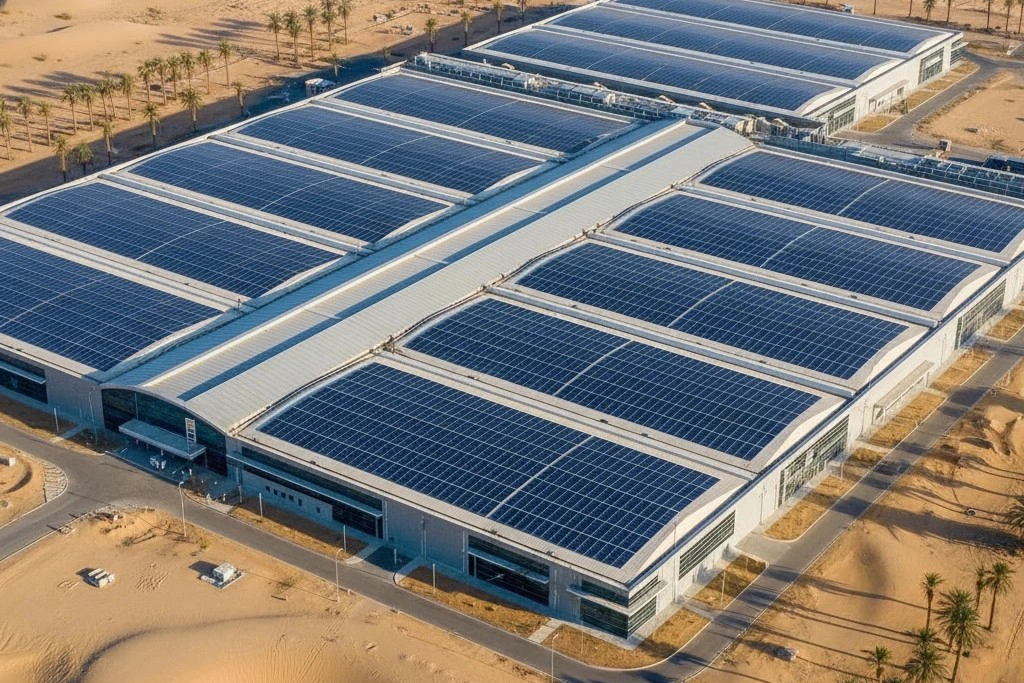
Why warehouses are ideal for solar installation
Warehouses are one of the best use cases for solar energy because they have large roof areas, high daytime electricity usage, and predictable energy demand.
Most warehouses operate during daylight hours, which aligns perfectly with solar generation. This makes solar systems highly efficient and cost-effective for logistics facilities.
Large flat rooftops also allow easy installation of solar panels without major structural changes.
Electricity consumption in logistics facilities
Warehouses consume significant amounts of electricity due to:
- Lighting systems (often running for long hours)
- Cooling and ventilation systems
- Automated logistics and machinery
- Charging equipment for electric forklifts
Energy consumption can vary widely depending on the size and operation of the facility, but it is typically stable and predictable—making it ideal for solar optimization.
Typical solar system size for warehouses
The size of a solar system depends on the warehouse’s energy demand and available roof space.
100kW solar system example
- Suitable for small warehouses
- Can cover a portion of daily energy needs
- Reduces electricity bills significantly
300kW solar system example
- Medium-sized logistics facilities
- Covers a large share of daytime consumption
- Strong ROI within a few years
500kW solar system example
- Large warehouses and distribution centers
- Can offset most daytime electricity usage
- Ideal for high-consumption operations
System sizing must be based on real consumption data and site conditions.
Energy savings for warehouse operators
Solar energy can reduce operating costs significantly.
Key benefits:
- Lower electricity bills
- Protection against rising energy prices
- Long-term cost stability
- Improved sustainability profile
In many cases, warehouses in the UAE can achieve 20% to 50% energy cost savings depending on system size and usage patterns.
Solar carports for logistics centers
In addition to rooftops, warehouses can use parking areas for solar generation.
Solar carports:
- Generate additional electricity
- Provide shade for vehicles
- Improve land use efficiency
This is especially useful for large logistics hubs with extensive parking spaces.
For warehouse operators, solar is not just an energy upgrade—it is a cost optimization strategy.
The biggest impact comes from correctly sizing the system based on real consumption.
👉 Businesses looking to evaluate feasibility and ROI can work with Arni Energy to design optimized solar solutions.
FAQ
Can warehouses run on solar power?
Yes, warehouses can cover a significant portion of their energy needs with solar systems.
How much solar capacity does a warehouse need?
It depends on energy consumption, but systems typically range from 100kW to 500kW or more.
Is rooftop solar suitable for warehouses?
Yes, warehouses are among the best candidates for rooftop solar installations.
How much can warehouses save with solar?
Savings typically range between 20% and 50% of electricity costs.
Final Insight
Warehouses represent one of the most practical and high-return applications of solar energy. Their energy profile, space availability, and operational patterns make them ideal for commercial solar adoption.
Management Perspective
“Solar for warehouses is one of the most efficient entry points into commercial energy optimization. The combination of scale, demand, and space creates immediate value.”
— Dr. Roshandel