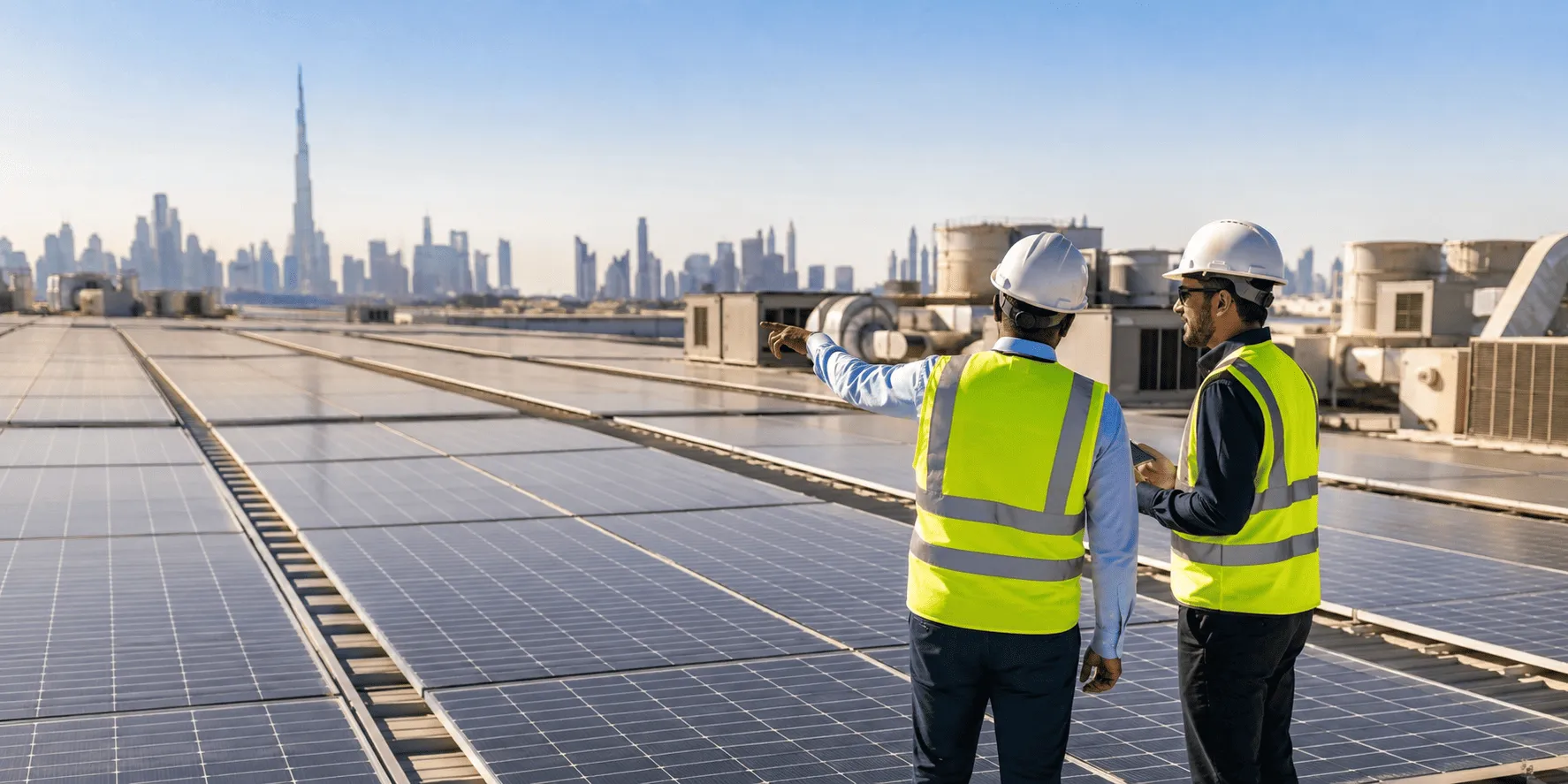
With rising energy costs and increasing pressure on businesses to reduce operational expenses, many companies in the UAE are considering installing solar systems on commercial rooftops such as warehouses, factories, logistics centers, and office buildings. However, before making any investment decision, it is essential to determine whether the building is technically and economically suitable for a solar project.
A solar feasibility study helps businesses evaluate potential system capacity, expected energy production, cost savings, and overall return on investment before committing capital.
Why Feasibility Studies Matter Before Solar Installation
Not every building is suitable for a rooftop solar system. Factors such as roof size, structural strength, energy consumption, and existing rooftop equipment can significantly impact the final system design and output.
A proper feasibility study helps answer key questions such as:
- What system capacity can realistically be installed?
- How much electricity can be generated?
- What will be the annual cost savings?
- What is the expected payback period?
- Are there any technical or structural limitations?
These insights form the foundation for investment decisions and project planning.
Which Buildings Are Most Suitable for Rooftop Solar?
Solar projects are typically more effective in buildings with both sufficient roof space and high electricity consumption. In such cases, the generated energy can directly offset operational costs.
Common suitable sites include:
- Warehouses and logistics centers
- Manufacturing facilities
- Office buildings
- Commercial malls and retail centers
- Cold storage facilities
- Industrial complexes and data centers
In general, the higher the energy consumption, the stronger the economic case for solar adoption.
Key Factors Evaluated in a Solar Feasibility Study
Feasibility studies go beyond simply measuring available roof space. Several technical and operational factors must be analyzed to create an accurate project assessment.
Key evaluation criteria include:
- Usable rooftop area
- Structural load capacity
- Solar irradiation levels
- Panel orientation and tilt potential
- Annual electricity consumption
- Technical and installation constraints
- Grid connection conditions
Together, these factors determine whether the project is technically viable and financially justified.
The Role of Energy Consumption in Project Viability
Energy consumption patterns are one of the most critical elements in determining project success. Two buildings with similar roof sizes may produce very different financial outcomes depending on their usage patterns.
Typically, historical electricity bills are analyzed to understand:
- Peak consumption periods
- Total annual electricity usage
- How much of the demand can be covered by solar energy
The closer the alignment between solar generation and actual consumption, the higher the financial efficiency of the system.
How Is System Capacity Determined?
Solar system capacity is not based solely on available rooftop space. Structural limitations, existing rooftop installations, and electricity demand all influence the final system size.
In commercial projects, the goal is not always to install the maximum possible capacity, but to design a system that delivers the best economic return.
Therefore, final capacity is usually defined based on a combination of available space, energy consumption, and investment objectives.
Evaluating Return on Investment (ROI)
One of the main concerns for businesses is the financial return of a solar project. ROI depends on several factors, including installation cost, energy production, electricity tariffs, and the selected business model.
Key elements considered in ROI analysis include:
- Initial project cost
- Annual electricity generation
- Energy cost savings
- Maintenance expenses
- System lifespan
- Project structure (EPC or PPA model)
The purpose of this analysis is to provide a realistic long-term financial outlook.
Common Challenges in Rooftop Solar Projects
While many commercial buildings are suitable for solar installation, certain challenges must be addressed during the feasibility stage.
Common issues include:
- Limited usable roof space
- Shading from nearby structures or equipment
- Structural load limitations
- Future building expansion plans
- Grid connection constraints
Identifying these risks early helps avoid costly redesigns or project delays later.
When Is a Solar Project Considered Viable?
There is no fixed threshold that applies to all projects. A solar installation is considered viable when the combination of system capacity, energy consumption, installation cost, and expected savings results in a positive long-term value.
This is why feasibility studies are essential—they replace assumptions with data-driven decision-making.
Feasibility Study as the First Step Toward Successful Investment
Installing rooftop solar systems can significantly reduce energy costs and improve operational efficiency for commercial buildings. However, the success of such projects begins with a detailed feasibility assessment.
By analyzing roof conditions, energy usage, installation capacity, and financial returns, businesses can make informed decisions and choose the most suitable investment model for their needs.
Frequently Asked Questions
Are all commercial buildings suitable for rooftop solar?
No. Structural conditions, available space, energy consumption, and technical limitations must all be evaluated.
What is the most important part of a feasibility study?
System capacity estimation, energy production potential, and ROI analysis are the most critical components.
Is rooftop area the only factor that matters?
No. Energy consumption, structural strength, shading, and grid conditions also play major roles.
How is solar system capacity determined?
It is based on available roof space, energy demand, structural constraints, and project objectives.
Why is a feasibility study necessary?
It reduces investment risk and ensures decisions are based on real technical and financial data rather than assumptions.