Green hydrogen converts renewable electricity into a fuel and industrial feedstock that can be stored, transported or used in processes that are difficult to electrify directly.
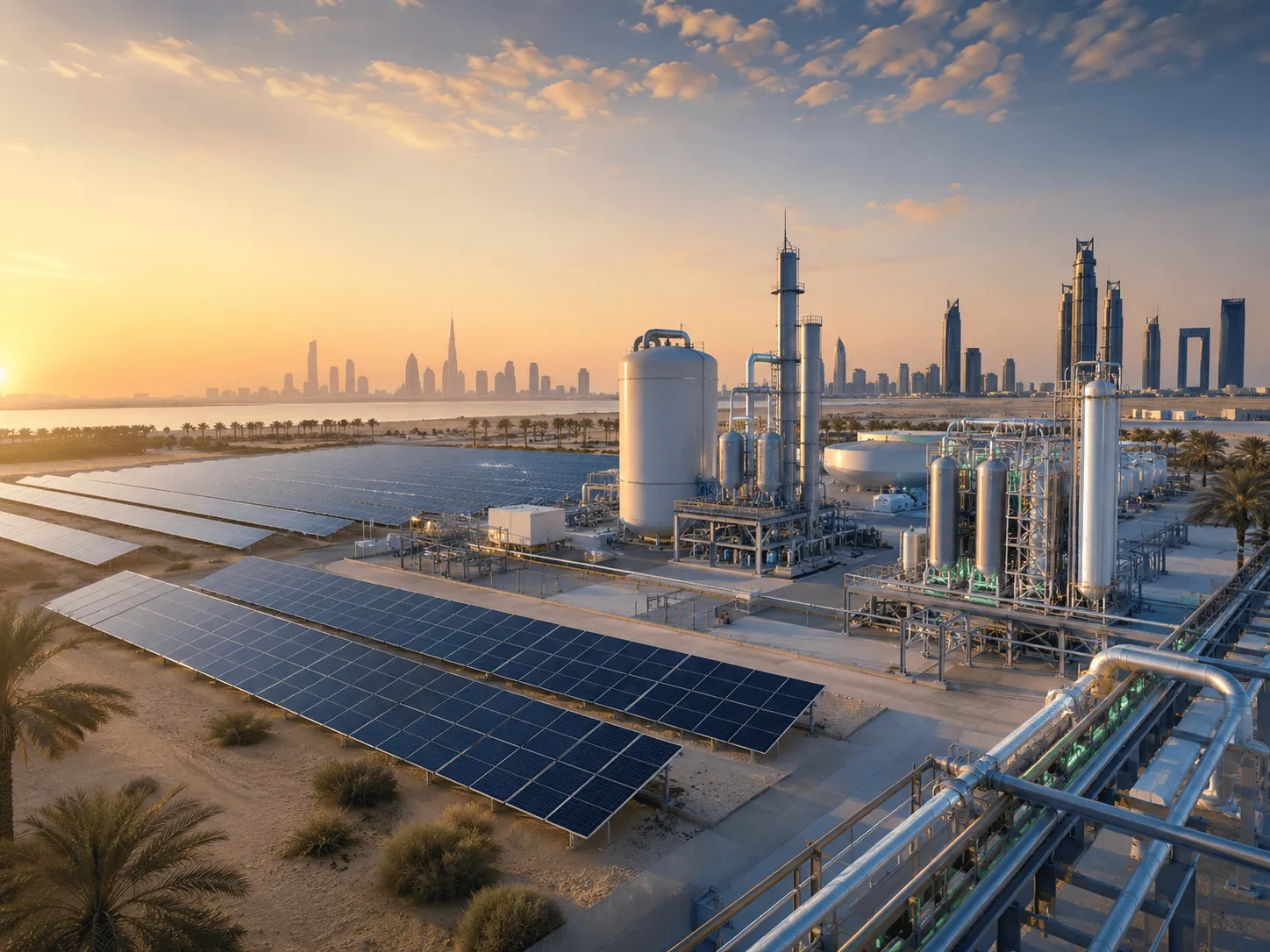
In a solar-powered project, photovoltaic panels generate electricity for an electrolyser. The electrolyser uses that electricity to split purified water into hydrogen and oxygen. The hydrogen is then treated, compressed or converted into another product according to its final use.
The UAE combines strong solar resources with industrial demand, export infrastructure and a national strategy for developing low-emission hydrogen. However, a viable project requires more than connecting a solar plant to an electrolyser. The renewable power profile, water supply, hydrogen demand, storage method and delivery route must be designed as one system.
Arni Energy develops green hydrogen solutions around renewable power integration, production facilities, safety, control, diagnostics, compression, storage and transport requirements.
How Is Green Hydrogen Produced from Solar Energy?
Solar-powered hydrogen production follows a connected process:
- Solar photovoltaic panels generate direct-current electricity.
- Inverters and power electronics condition the electricity for the plant.
- Water is treated to meet the electrolyser’s purity requirements.
- The electrolyser separates water into hydrogen and oxygen.
- The hydrogen is dried and purified to the required specification.
- Compression or conversion prepares it for storage, transport or use.
The process itself does not release carbon dioxide. However, the hydrogen can only be considered green when the electricity used for electrolysis comes from qualifying renewable sources and the project can demonstrate the origin and carbon intensity of that electricity.
This distinction becomes important when an electrolyser uses both solar electricity and grid power.
Why Is the UAE Developing Green Hydrogen?
The UAE National Hydrogen Strategy 2050 is intended to strengthen the country’s position as a producer and supplier of low-emission hydrogen. Its direction includes developing supply chains, hydrogen production hubs and research capabilities.
For businesses, the opportunity is connected to practical demand rather than hydrogen production alone. Potential uses include:
- Replacing fossil-based hydrogen in industrial processes.
- Supplying low-emission feedstock for chemicals and fertilisers.
- Supporting green ammonia, methanol and synthetic fuel production.
- Providing fuel for selected heavy transport applications.
- Storing renewable energy for uses where direct electrification is unsuitable.
A project becomes commercially stronger when the buyer, product specification and delivery method are identified before the production plant is sized.
Where Can Solar Hydrogen Be Used?
Hydrogen should be directed toward applications where its technical value justifies the additional conversion, compression and handling requirements.
Industrial Hydrogen
Refineries, chemical plants and other industrial facilities already use hydrogen as a process input. Green hydrogen can replace part of the hydrogen produced from fossil fuels when the new supply meets the required purity, pressure and reliability.
Locating production near the industrial consumer can reduce transport and storage requirements.
Green Ammonia and Other Hydrogen Derivatives
Hydrogen can be combined with other inputs to produce ammonia, methanol or synthetic fuels.
These derivatives may be easier to store or transport than hydrogen gas, but each additional conversion stage requires equipment and energy. The project must therefore evaluate the final delivered product rather than only the cost of hydrogen leaving the electrolyser.
Heavy Transport
Hydrogen may be considered for fleets that require fast refuelling, long operating ranges or high payloads.
The production plant cannot be assessed separately from the refuelling stations, vehicle demand, delivery logistics and required hydrogen pressure. Without consistent fleet demand, the utilisation of the production and refuelling infrastructure may remain low.
Renewable Energy Storage
Hydrogen can store energy over longer periods and later supply industrial processes, fuel cells or power generation.
It is not usually the most efficient solution for short-duration electricity storage because energy is lost during electrolysis, compression and conversion back to electricity. Its value is stronger where long-duration storage or a usable hydrogen product is required.
How Should Solar Power Be Connected to the Electrolyser?
The electricity configuration affects operating hours, hydrogen output and production cost.
| Power configuration | How it operates | Main consideration |
| Direct solar connection | The electrolyser follows available solar production | Lower operating hours and variable output |
| Solar with grid connection | Grid power supports production outside solar hours | Renewable electricity origin must be verified |
| Solar with battery storage | Batteries smooth short-term changes or shift limited energy | Adds cost and does not usually provide full overnight operation |
| Oversized solar plant | Additional PV capacity increases electrolyser operating hours | Creates periods of excess electricity or curtailment |
| Hybrid renewable supply | Solar is combined with another renewable source | Can produce a more stable power profile |
An electrolyser sized equal to the peak solar capacity may operate below full load for much of the day. A smaller electrolyser may achieve higher utilisation but may not absorb all available solar electricity.
The optimum design depends on the value of higher hydrogen output compared with the cost of additional solar capacity, storage or grid electricity.
Which Electrolyser Technology Is Suitable for Solar Hydrogen?
The main commercial options include alkaline and Proton Exchange Membrane electrolysers, commonly known as PEM electrolysers. Solid oxide electrolysis may also be considered where high-temperature heat is available, although its operating requirements are different.
| Electrolyser type | Main strength | Project consideration |
| Alkaline | Established technology for large-scale production | Generally prefers steadier operating conditions |
| PEM | Fast response and suitability for variable renewable power | Uses different materials and may have a higher equipment cost |
| Solid oxide | Can achieve high efficiency when suitable heat is available | Requires high operating temperatures and a compatible industrial site |
Technology selection should consider more than nameplate efficiency. Minimum operating load, start-up time, pressure, hydrogen purity, water quality, maintenance, stack replacement and response to changing solar output all affect the project.
The selected supplier should provide a clear operating envelope rather than only a rated production figure.
How Much Solar Capacity Is Needed?
Solar and electrolyser capacity cannot be calculated from annual hydrogen demand alone.
The project model needs an hourly or sub-hourly solar profile to show when electricity is available and how the electrolyser will respond. Annual averages can hide daytime peaks, seasonal differences and periods of low solar production.
The model should define:
- Required hydrogen production per hour, day and year.
- Electrolyser power consumption and operating range.
- Solar capacity and expected generation profile.
- Planned operating hours.
- Permitted grid electricity use.
- Battery or hydrogen storage requirements.
- Expected renewable electricity curtailment.
- Availability and maintenance assumptions.
Hydrogen demand also matters. A plant supplying a continuous industrial process may need storage or backup arrangements even when annual solar generation appears sufficient.
What Water Supply Does a UAE Green Hydrogen Plant Need?
Electrolysis requires purified water, not untreated seawater or ordinary process water.
The water system may use desalinated water, municipal supply or treated water, depending on the site and the required approvals. It must then remove minerals and impurities to meet the electrolyser manufacturer’s specification.
A complete assessment includes:
- Raw water source and availability.
- Pre-treatment and purification.
- Water required by the electrolyser.
- Cooling and cleaning demand.
- Treatment losses.
- Reject water or brine management.
- Storage and backup supply.
Water use should be evaluated early, particularly for projects located away from existing industrial or utility infrastructure.
Desalination does not prevent a project from producing green hydrogen, but the electricity used for water treatment and the related infrastructure should be included in the energy and carbon assessment.
How Are Variable Solar Output and Hydrogen Demand Balanced?
Solar production changes throughout the day, while the hydrogen consumer may require a stable supply.
The project can manage this mismatch through a combination of:
- Flexible electrolyser operation.
- Additional solar capacity.
- Grid support under an approved electricity arrangement.
- Battery storage for short-duration power balancing.
- Compressed hydrogen storage.
- Conversion into ammonia or another derivative.
- Adjustment of the industrial production schedule.
Hydrogen storage can separate the time of production from the time of use. However, compression, tanks and safety systems increase the site area, energy consumption and capital cost.
The selected solution should reflect the actual demand profile. Adding both large batteries and large hydrogen storage without a clear operational need can make the project unnecessarily expensive.
Green Hydrogen Storage and Delivery Options
Hydrogen has a low energy density by volume, so storage and delivery can represent a significant part of the project.
The main options include:
Compressed Hydrogen
Hydrogen gas is compressed and stored in suitable pressure vessels. This approach can serve onsite demand, refuelling or shorter delivery routes.
Compression consumes electricity, and higher pressure requires more specialised equipment and safety measures.
Pipeline Delivery
A pipeline may be suitable where a large and consistent consumer is located close to the production plant.
The feasibility depends on distance, flow, pressure, material compatibility, route approval and long-term demand.
Conversion to Ammonia or Other Derivatives
Conversion can support industrial use or longer-distance transport. It also adds another production plant and introduces conversion losses.
The economic assessment should cover the complete pathway from renewable electricity to the product received by the customer.
Safety Requirements for Green Hydrogen Facilities
Hydrogen is light, highly flammable and able to escape through very small openings. Safe project development requires controls designed specifically for hydrogen service.
The plant design should address:
- Hazardous area classification.
- Natural and mechanical ventilation.
- Hydrogen leak detection.
- Fire and gas systems.
- Emergency shutdown and isolation.
- Pressure relief and safe discharge.
- Separation distances.
- Compatible piping, valves and seals.
- Earthing and electrical protection.
- Controlled vehicle and personnel access.
Compression, storage and loading areas require particular attention because they combine hydrogen inventory with high pressure.
Safety must be integrated into the layout during early engineering. It is more difficult and costly to create suitable separation and access after major equipment positions have been fixed.
What Determines the Cost of Green Hydrogen?
Renewable electricity is one of the main production cost drivers, but it is not the only one.
The delivered hydrogen cost is influenced by:
- Solar plant capital cost and energy output.
- Electrolyser cost, efficiency and utilisation.
- Water treatment and cooling.
- Power conversion equipment.
- Compression and purification.
- Hydrogen storage.
- Pipeline, trailer or derivative production.
- Land and infrastructure.
- Maintenance and stack replacement.
- Financing and project risk.
- Certification and regulatory compliance.
High electrolyser utilisation can reduce the capital cost allocated to each kilogram of hydrogen, but operating for more hours may require grid electricity, storage or additional renewable generation.
The lowest-cost production configuration is not necessarily the lowest-cost delivery solution. The project must be assessed up to the point where the customer receives hydrogen at the required pressure, purity and schedule.
What Makes a UAE Green Hydrogen Project Commercially Viable?
A strong project starts with a defined offtake arrangement.
Before moving into detailed engineering, the developer should confirm:
- Who will purchase the hydrogen or derivative?
- What annual and hourly volume is required?
- What purity and delivery pressure are needed?
- Will the customer accept variable supply?
- How will renewable electricity be demonstrated?
- Where will water come from?
- How will the product be stored and delivered?
- Which permits, standards and certification rules apply?
- What price can the final application support?
- Can the project expand when demand increases?
A technically operational electrolyser is not automatically a viable hydrogen business. Low equipment utilisation, uncertain demand or an expensive delivery route can weaken the project even when solar electricity is available.
Developing Solar-Powered Hydrogen Solutions with Arni Energy
Arni Energy approaches green hydrogen as a connected energy system rather than an isolated electrolyser installation.
Our scope considers renewable power and facility management, energy-efficiency concepts, safety and protection systems, condition-based analysis, diagnostics, hydrogen compression, storage and transport infrastructure.
We also examine industrial use, mobility and hydrogen as an energy carrier when developing a project concept.
Contact Arni Energy to discuss the renewable electricity, production, storage and delivery requirements of a green hydrogen project in the UAE.
Frequently Asked Questions
Is hydrogen produced with any solar electricity automatically green?
Not necessarily. The project must demonstrate that the electricity used for electrolysis is renewable and that the defined production pathway meets the applicable carbon-intensity and certification requirements.
Can an electrolyser operate directly from solar panels?
Yes, but its output will change with solar production unless the system includes grid support, batteries or another renewable source. The electrolyser must also be suitable for variable operation.
Is seawater used directly in a green hydrogen electrolyser?
Commercial electrolysers generally require purified water. Seawater can be desalinated and treated before use, but it is not normally supplied directly to the electrolyser stack.
Does a solar hydrogen project always require batteries?
No. Batteries may support short-term power balancing, but flexible electrolyser operation or hydrogen storage may be more appropriate. The need depends on the solar profile and hydrogen demand.
What is the most important factor in green hydrogen project feasibility?
A reliable customer or offtake plan is essential. The required volume, purity, pressure, delivery schedule and acceptable price determine how the production system should be designed.