UAE businesses considering onsite solar power usually have three main installation options: rooftop solar, ground-mounted solar and solar carport systems. Each option uses photovoltaic panels to generate electricity, but the required space, structural design, installation cost, maintenance access and additional business value can differ significantly.
The right choice depends on more than available sunlight. Businesses need to consider their electricity demand, property layout, roof condition, parking requirements, future expansion plans and the approval framework applicable in the relevant emirate.
Arni Energy provides rooftop, ground-mounted and solar carport solutions for commercial and industrial sites. The project should begin with a site-specific assessment rather than selecting a system type before the available space and operational requirements have been reviewed.
Ground-Mounted vs Rooftop vs Solar Carport: Key Differences
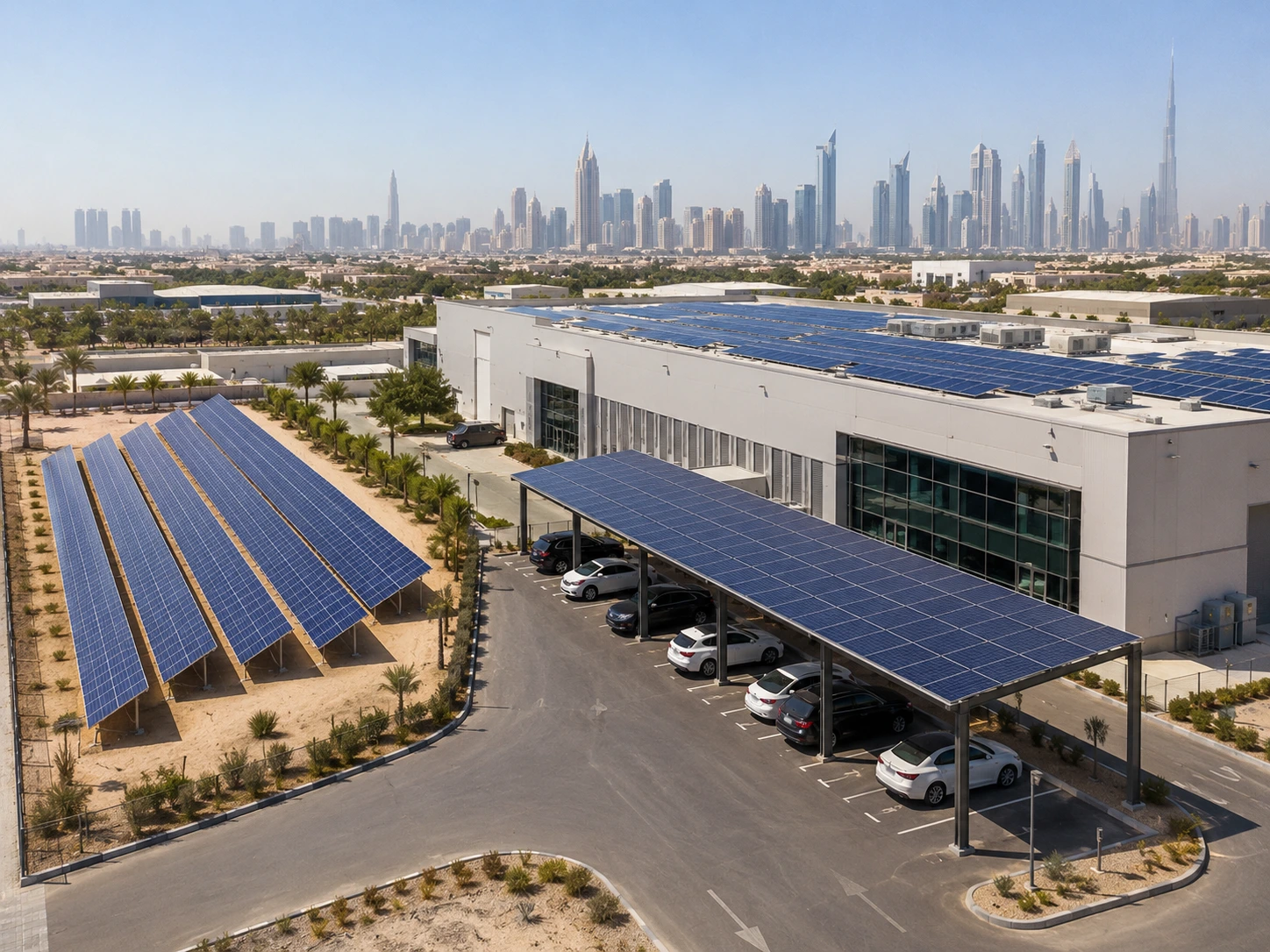
Rooftop systems use the existing roof of a warehouse, factory, office or commercial building. Ground-mounted systems are installed on dedicated land using independent support structures. Solar carports place photovoltaic panels above parking spaces, combining electricity generation with shaded parking.
| Decision area | Rooftop solar | Ground-mounted solar | Solar carport |
| Space used | Existing building roof | Open land within or near the site | Existing parking areas |
| Structural requirement | Roof capacity and condition must be verified | Requires foundations and ground preparation | Requires an engineered canopy structure |
| Typical project scale | Limited by usable roof area | Suitable for larger arrays where land is available | Limited by parking layout and canopy coverage |
| Maintenance access | Can be restricted by roof layout and height | Generally accessible from ground level | Accessible, but work must be coordinated with parking use |
| Additional function | Uses an otherwise underused roof | Allows flexible panel orientation and expansion | Generates power while providing shade |
| Main constraint | Roof condition, loading and obstructions | Land availability and site development | Higher structural scope and parking disruption |
| Visibility | Usually less visible from ground level | Depends on site location | Highly visible to staff, customers and visitors |
The most appropriate option is not always the system with the lowest initial installation cost. A business should compare usable capacity, expected generation, site disruption and long-term operating value.
When Is Rooftop Solar the Best Option for a Business?
Rooftop solar is suitable for businesses with large, strong and mostly unobstructed roofs.
Warehouses, factories, distribution centres, schools and retail buildings often have unused roof space that can generate electricity without using land or affecting parking areas. This makes rooftop solar ideal where land is limited or needed for future operations.
Before selecting this option, the roof should be checked for:
- Structural strength and load capacity
- Remaining service life of the roof
- Existing installations such as HVAC units, skylights and vents
- Shading from nearby buildings or structures
- Safe access for installation and maintenance
- Drainage and waterproofing condition
Roof condition is critical. Installing solar on a roof that may soon need repairs can lead to extra cost and disruption, as panels may need to be removed and reinstalled.
Rooftop systems can also be limited in size. Even large roofs often have reduced usable area once access paths, safety margins, equipment zones and shaded sections are excluded.
When Should a Business Choose Ground-Mounted Solar?
Ground-mounted solar is a strong option for commercial and industrial sites with available land and higher energy needs than the roof can support.
Because the system is installed independently of the building, it can be optimally positioned based on site conditions, panel orientation, spacing, and maintenance access, offering more flexibility than rooftop systems.
It is typically suitable when:
- The roof is too small or structurally unsuitable
- Spare or low-value land is available
- A larger solar capacity is required
- Future expansion is planned
- Easy access for cleaning and maintenance is important
- Independence from roof condition or future roof work is preferred
However, available land must be carefully evaluated, as it may still be needed for operations such as logistics, storage, access routes, drainage, utilities, or future development.
Ground-mounted systems also involve civil works such as site preparation, foundations, trenching, fencing, and cable routing, so soil conditions and underground services must be assessed before final design.
When Does a Solar Carport Provide Better Business Value?
A solar carport is most suitable when a business has large parking areas but limited roof or land space.
It installs panels on an engineered canopy over parking, enabling dual use: electricity generation and shaded parking. In the UAE, this also improves comfort for users and adds visible sustainability value.
Typical applications include:
- Shopping centres and retail sites
- Office buildings and business parks
- Schools and universities
- Hospitals and healthcare facilities
- Hotels and leisure venues
- Industrial and logistics sites with staff parking
- Public and customer parking areas
Its key benefit is turning parking space into a productive energy asset without using additional land. It can also be designed to support future EV charging infrastructure.
However, carports require more structural and civil work than rooftop systems, including foundations, columns, drainage, lighting, vehicle clearance and traffic planning. Construction may also temporarily reduce parking availability.
Which Solar System Produces More Electricity?
The system type alone does not determine electricity generation.
Expected production depends on the installed capacity, solar exposure, panel orientation, tilt, shading, equipment selection, temperature, soiling and system losses. A well-designed rooftop installation may perform better than a poorly positioned ground-mounted system, even though ground-mounted systems generally offer more layout flexibility.
The total available area is often more important than the mounting type. A large parking area may support more solar capacity than a small roof, while an open land parcel may allow a larger project than either alternative.
Businesses should therefore compare the expected annual generation of each feasible layout rather than assuming that one category always performs better.
How UAE Site Conditions Affect Solar System Selection
Solar systems in the UAE must be designed for local environmental and operating conditions.
Heat and Equipment Performance
High ambient temperatures can affect the performance of photovoltaic modules and electrical equipment. Airflow around the panels, inverter location and equipment specifications should be considered during design.
Rooftop systems may be exposed to additional heat from the building surface, while ground-mounted and carport systems can offer more open airflow depending on their configuration.
Dust, Sand and Cleaning Access
Dust and sand accumulation can reduce the amount of sunlight reaching the panel surface. Every system therefore requires a practical cleaning and inspection strategy.
Ground-mounted systems usually offer direct access. Rooftop systems may require controlled access routes and roof safety measures. Solar carports are accessible from parking areas, but cleaning activities must be coordinated to protect vehicles and avoid disrupting site traffic.
Wind and Structural Loads
Mounting structures must be engineered for the site’s wind conditions. This applies to all three system types, but the structural response is different for a roof, an independent ground structure and an elevated carport canopy.
Solar carports require particular attention to column spacing, foundation design and the large exposed canopy area. Rooftop systems require verification of both the mounting system and the existing building structure.
Corrosion and Material Selection
Coastal or industrial environments may expose structures and electrical components to more aggressive conditions. Material selection, protective coatings and equipment enclosure ratings should reflect the actual site environment.
How Do Roof Condition, Land Use and Parking Demand Affect the Decision?
The three options should be compared against the business’s property strategy, not only its current layout.
A rooftop system may appear to be the simplest choice, but it may be unsuitable if the building is leased, the roof requires replacement or future mechanical equipment will need additional space.
A ground-mounted system may support higher capacity, but using land for solar can reduce the space available for warehouse expansion, logistics operations or future development.
A solar carport preserves the main function of the parking area, but the design must accommodate vehicle circulation, accessible parking, emergency routes and the required clearance for different vehicle types.
For sites with multiple usable areas, the answer may not be limited to one system type.
Can a Business Combine Rooftop, Ground-Mounted and Carport Solar?
Yes. A hybrid site layout can combine two or all three mounting systems where one installation area cannot support the required capacity.
For example, a business may use the warehouse roof as the first installation area, expand over employee parking with solar carports and add a ground-mounted section on unused land.
A combined project can increase onsite solar capacity, but it also requires coordinated electrical design. Cable routes, inverter locations, metering, protection systems and points of connection must be planned as parts of one integrated solar plant.
Using multiple areas should only continue while each additional section remains technically practical and commercially justified.
What Should UAE Businesses Compare Before Choosing a System?
A clear comparison should include the following factors:
- Electricity consumption: Review annual usage, daytime demand and seasonal changes to determine the practical system size.
- Usable installation area: Measure the roof, land and parking areas after excluding obstructions, access routes and safety clearances.
- Structural and civil conditions: Assess roof loading, soil conditions, foundations and existing underground services.
- Expected generation: Model the capacity and annual production of each feasible option using the actual site layout.
- Installation impact: Consider roof access, parking closures, civil works and disruption to normal business operations.
- Maintenance requirements: Confirm how panels, inverters, structures and cables will be inspected, cleaned and repaired.
- Future site plans: Account for roof replacement, building extensions, parking changes and possible electric vehicle charging.
- Approval and grid connection: Identify the requirements of the relevant emirate, utility and property authority before finalising the project schedule.
The best option is the one that provides suitable generation without creating avoidable restrictions for the business.
Solar Approvals and Grid Connection in the UAE
Grid-connected solar projects must follow the technical and procedural requirements applicable to their location.
In Dubai, eligible grid-connected photovoltaic systems are developed under the Shams Dubai framework. The process involves technical documentation, design approval, inspection, metering and connection requirements.
Businesses in other emirates must review the framework of the relevant electricity authority and any requirements applying to the property, free zone, industrial area or development.
The approval process may affect equipment selection, system capacity, protection design, metering and project timing. It should therefore be considered during feasibility assessment rather than after the installation layout has been completed.
How Arni Energy Evaluates Rooftop, Ground-Mounted and Carport Projects
Arni Energy provides turnkey solar solutions covering design, procurement, construction, installation, commissioning and maintenance.
We evaluate the available roof, ground and parking areas before recommending a system configuration. For ground-mounted projects, the site and installation area are assessed before a customised solution is developed. For solar carports, the parking layout, structural requirements and panel arrangement are considered together.
Arni Energy can also develop combined solar layouts where different areas of the same commercial or industrial site need to be used within one project.
Contact Arni Energy to compare rooftop, ground-mounted and solar carport options for your business site in the UAE.
Frequently Asked Questions
Is rooftop solar cheaper than a solar carport?
Rooftop solar may require less new structural work when the existing roof is suitable. A solar carport requires a dedicated canopy and foundations, but it also provides shaded parking and uses an area that may otherwise have no energy function.
Is ground-mounted solar only suitable for large solar farms?
No. Ground-mounted systems can also be installed within commercial or industrial properties when sufficient land is available and the roof cannot support the required capacity.
Can solar panels be installed on an existing carport?
Possibly, but the existing structure must be assessed for additional panel weight, wind loads, electrical requirements and long-term structural performance. Some carports may require strengthening or replacement.
Which option is easier to maintain?
Ground-mounted systems generally offer straightforward access. Rooftop and carport systems can also be maintained effectively when safe access, cleaning routes and equipment replacement requirements are included in the design.
Can one business use all three solar installation types?
Yes. Rooftop, ground-mounted and carport systems can be combined when the electrical design, approvals, connection capacity and site operations support an integrated solution.